304L and 316L stainless material handling equipment designed cleanroom-native — not adapted from industrial stock. Certified to ISO 14644 for Class 5 through Class 8 environments, with full qualification documentation in the crate.
Standard industrial material handling equipment is engineered for warehouses, loading docks and manufacturing floors where contamination control is not a design requirement. When that equipment enters a cleanroom, it brings every contamination source along: particle-shedding paint, open hydraulic reservoirs, carbon-steel surfaces that corrode and shed, open-weave components that trap and release debris, and crevice geometries that defeat any cleaning protocol.
The result is not a matter of degree — it is a classification failure. Introducing a standard pallet truck into an ISO Class 7 pharmaceutical or medical device cleanroom creates an uncontrolled particle source that invalidates the environmental monitoring programme the facility has invested months establishing.
Jesterlift cleanroom material handling equipment is engineered from first principles for classified environments. The contamination sources present in standard equipment are eliminated, not mitigated — through 304L and 316L stainless construction, electropolished surfaces, enclosed hydraulics, anti-static design and the complete removal of paints, open fabrics and crevice geometries from the product.
Cleanroom certification is not a label applied to a standard product. It is the outcome of specific engineering decisions made at every level of the design — materials, geometry, actuation, surface finish and electrostatic management.
Electropolished 304L and 316L stainless surfaces generate no paint particles, no rust particles and no fiber contamination. ISO 14644 cleanroom qualification testing verifies particle counts at every class level — Jesterlift units pass Class 7 as standard, with Class 5 and 6 available on request.
Standard equipment is assembled with crevice geometries — gaps between components, open fastener threads, recessed bolt heads — that trap contamination and resist cleaning. Jesterlift cleanroom units use crevice-free weld geometry, flush fasteners and continuous-weld construction to eliminate every trap site.
Mechanical polishing leaves a directional surface pattern with micro-peaks that anchor contamination. Electropolishing removes those peaks electrolytically, producing a mathematically smoother, isotropic surface that is certifiably cleaner, more corrosion-resistant and easier to sanitise. Ra values are measured and reported on every unit.
Static charge accumulation on equipment surfaces attracts and holds sub-micron particles, defeating even the most thorough cleaning protocol. Jesterlift cleanroom units are built with anti-static materials and conductive grounding paths throughout, preventing static-driven particle adhesion in the lowest-particle-count environments.
Conventional hydraulic systems use open or semi-open reservoirs that allow hydraulic fluid to contact classified air. Jesterlift cleanroom units use fully enclosed hydraulic systems with sealed reservoirs and positive-seal fittings — eliminating aerosol generation and fluid contamination risk across all normal operating conditions.
ISO 14644 defines cleanroom classes by airborne particle concentration. Jesterlift material handling equipment is validated for the classes where material handling operations most commonly occur — from ISO Class 8 secondary packaging through ISO Class 5 aseptic filling.
| ISO Class | Typical application | Max particles ≥0.5 µm/m³ | JL-PPT 1500 Pallet Truck | JL-ML 22 Manlift | JL-INV 180 Inverter |
|---|---|---|---|---|---|
| ISO Class 5 | Aseptic fill-finish, semiconductor lithography | 3,520 | ✓ Compatible 316L + enhanced EP |
✓ Compatible 316L + enhanced EP |
| ISO Class 6 | Sterile drug manufacturing, medical implant assembly | 35,200 | ✓ Compatible 316L standard |
✓ Compatible 316L standard |
| ISO Class 7 | Pharma manufacturing, biotech, medical device | 352,000 | ✓ Standard spec | ✓ Standard spec | ✓ Standard spec |
| ISO Class 8 | Food & beverage, packaging, secondary pharma | 3,520,000 | ✓ Standard spec | ✓ Standard spec | ✓ Standard spec |
316L stainless available on all units (+18%). Enhanced electropolish to Ra ≤0.25 µm available for ISO Class 5 applications. Contact us for class-specific validation documentation requirements.
Every Jesterlift unit is designed cleanroom-native — not an industrial machine with a stainless skin. The three products in the range cover the material handling tasks that classified environments most frequently require.
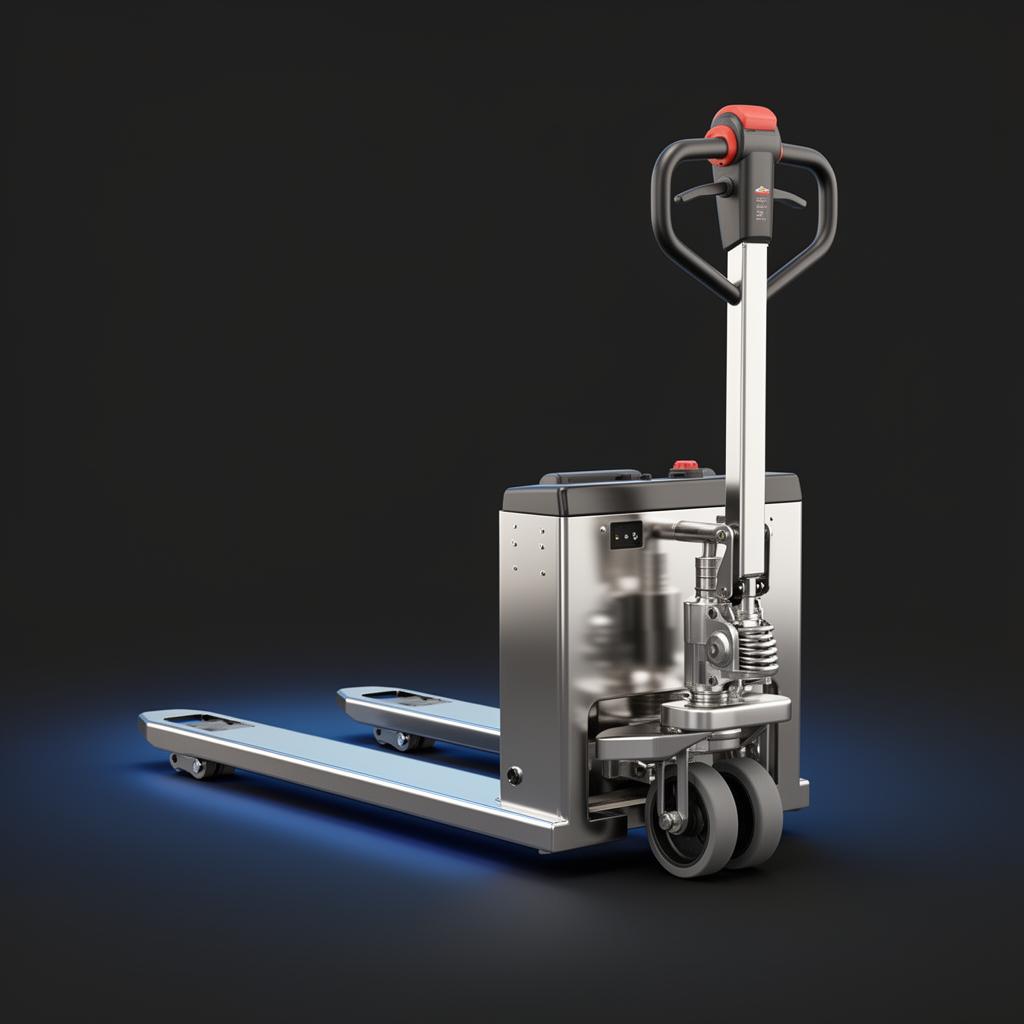
304L/316L · Ra ≤0.5 · IP65
1,500 kg electric drive pallet truck engineered for ISO Class 7 and Class 8 cleanrooms. Electropolished 304L (or 316L pharma grade), enclosed hydraulics, IP65 washdown rating, crevice-free weld construction throughout.
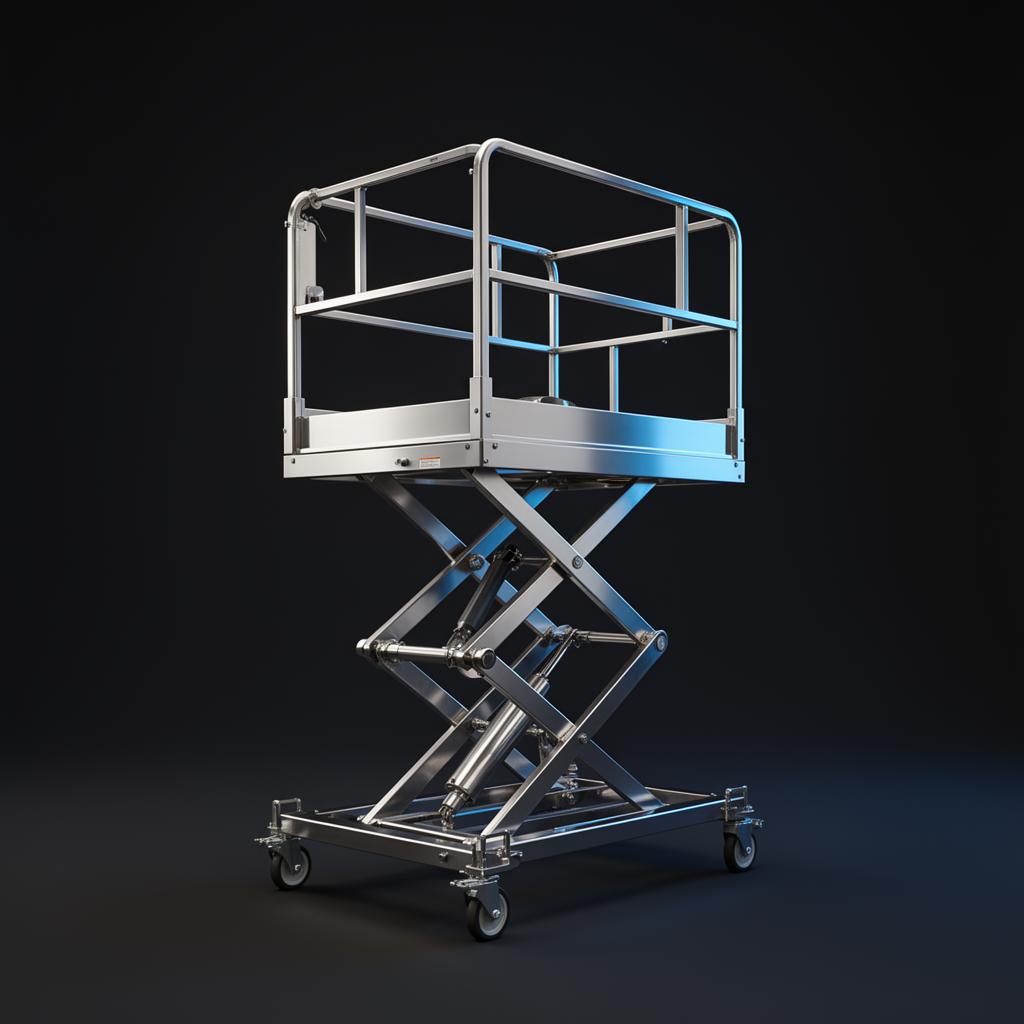
304L/316L · Ra ≤0.5 · IP66
Pneumatic manlift with 2.2 m working platform height. Zero-spark, zero-ESD air actuation for classified environments. IP66 washdown, GMP Annex 1 compliant, anti-static construction throughout — the only safe personnel lift for ATEX cleanrooms.
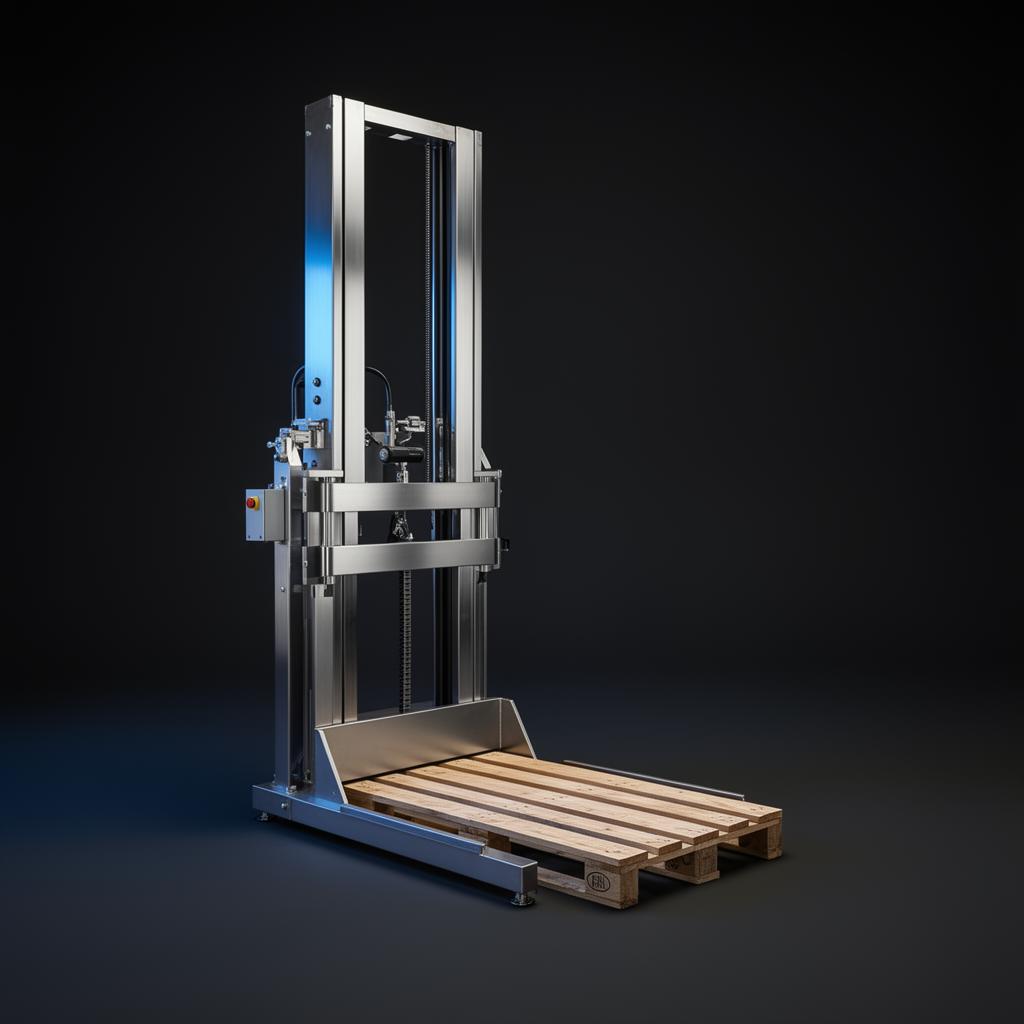
304L/316L · Ra ≤0.5 · 3-A
180° hydraulic rotation for cleanroom pallet exchange and product transfer. FDA epoxy contact surfaces, 3-A Sanitary standard, 60-second cycle. Eliminates the need to transfer non-cleanroom pallets across suite boundaries.
ISO 14644 classified environments exist across a wide range of regulated industries. Jesterlift equipment is deployed in each of them — because the contamination control requirements, and therefore the equipment specification, are fundamentally the same.
API manufacturing, fill-finish, secondary packaging. GMP Annex 1 and FDA 21 CFR Part 211 compliance standard.
Cell culture, fermentation and upstream/downstream bioprocessing suites with ISO Class 6–7 requirements.
Implant and device assembly cleanrooms under ISO 13485 quality management systems. ISO Class 7 and Class 6 compatible.
High-care and high-hygiene zones under FSMA and Canadian SFCR. 3-A Sanitary and USDA-compliant construction.
Wafer fabrication and advanced packaging environments at ISO Class 5–6. ESD-safe construction standard across all units.